Abstract
Dynamic topology reconfiguration is central to the reliability and efficiency of large satellite constellations, yet many existing approaches rely on idealized assumptions such as full constellation deployment or uniform orbital spacing. We present Adaptive Satellite Topology via Regret-Aware learning (ASTRA), a theoretically-grounded framework for dynamic satellite topology reconfiguration that builds on an online learning formulation and makes it computationally practical. ASTRA combines an ADMM-based offline solver with efficient online updates for both online gradient descent and online conditional gradient, yielding markedly cheaper constrained updates than generic optimization pipelines. On the theory side, we show that for a relevant class of entry-wise nonzero utility matrices, the objective is strongly convex, which yields logarithmic static regret for online gradient descent, and we further instantiate known dynamic-regret guarantees under inexact ADMM inner loops. Empirically, ASTRA matches or improves topology quality, presenting a good trade-off with computational time on synthetic constellations, and it remains effective on real Starlink data under partial deployment and non-uniform spacing, where idealized structural assumptions break down. These results position ASTRA as an efficient and theoretically grounded approach to topology reconfiguration in realistic Low Earth Orbit networks.
Main Contributions
Our recent work, General Utility Topology Optimization (GUTO) , formulated dynamic constellation topology reconfiguration as a convex optimization problem with flexible utility design and showed that generic online methods such as OGD and OCG can be applied to adapt to time-varying settings. Our contribution is not a new problem formulation. Instead, we make that formulation substantially more practical and theoretically sharper through a problem-specific optimization treatment and stronger guarantees. Specifically, we:
- Derive a problem-structured ADMM solver for topology optimization of satellite networks. We show that the topology optimization problem of our GUTO work can be solved offline with an ADMM-based algorithm tailored to the Laplacian constraints, replacing generic solver calls with problem-specific updates.
- Accelerate the online methods. Building on the observation of Norberto et al. that OGD and OCG are applicable to this setting, we derive ADMM-based subroutines for their constrained updates, yielding substantially cheaper online iterations than generic optimization pipelines.
- Establish stronger regret guarantees for this topology objective. We prove that, for a useful class of entry-wise nonzero utility matrices, the objective is strongly convex. This implies logarithmic static regret for OGD against any fixed topology comparator, strengthening the theoretical understanding of online topology reconfiguration in this setting.
- Connect the theory to the implemented inexact solver. We further analyze dynamic regret under inexact ADMM inner loops via feasible-shadow arguments, and relate the regret degradation to infeasibility and ADMM primal residuals.
- Validate beyond idealized constellation assumptions. In contrast to classical topology-design methods that rely on full deployment or uniform orbital spacing, we show that the resulting framework remains effective on realistic Starlink data under partial deployment and non-uniform spacing. On real Starlink data, ASTRA preserves the connectivity quality of SOTA and attains the largest number of fully connected topologies, while offering substantially lower computational cost.
Results
Considered Metrics
We compare our method with the state-of-the-art on both synthetic and real-world data and present metrics for the graphs generated, viz, total number of edges in the graph, ``E''; average degree of a satellite, ``A-Deg''; number of connected components, ``CC''; average shortest path, ``A-SP''; and the wall clock time in seconds, ``Time (s)''. Wall clock time experiments were executed on an M5 Pro MacBook Pro CPU, with Starlink metric experiments executed in 1 core of an Intel(R) Xeon(R) Gold 6330. Our synthetic dataset consists of an Iridium-like constellation with six elliptical orbital planes, each one with eleven satellites per plane. For real-world data, we consider a constellation with 1591 Starlink satellites, distributed across 50 orbital planes, containing between 14 and 64 satellites, whose state was retrieved every five minutes, during a period of 24 hours.Iridium-like Constellation
In the following table we summarize the results of ASTRA and the different methods we compare it with in an Iridium-like constellation. We see that +Grid and ×Grid are the fastest methods, although the latter presents the lowest connectivity metrics and the highest shortest path. Both Motif and DoTD achieve the best network connectivity out of all the methods, although Motif takes a much longer time to achieve it. Both GUTO and ASTRA achieve smaller average shortest path length and comparable connectivity with DoTD and Motif. Furthermore, GUTO and ASTRA are equivalent, with ASTRA requiring approximately 22% less execution time.
| Metrics | E ↑ | A-Deg ↑ | CC ↓ | A-SP ↓ | Time (s) ↓ |
|---|---|---|---|---|---|
| +Grid | 130 | 3.94 | 1 | 4.036 | 0.001 |
| ×Grid | 124 | 3.76 | 1 | 4.978 | 0.001 |
| DoTD | 131 | 3.97 | 1 | 4.412 | 0.023 |
| Motif | 132 | 4.00 | 1 | 4.292 | 1.326 |
| GUTO | 128 | 3.88 | 1 | 3.767 | 0.091 |
| ASTRA | 128 | 3.88 | 1 | 3.767 | 0.071 |
Real-world Starlink Constellation
We evaluate our method and compare it to the state-of-the-art on Starlink data. At each time step, the algorithms are applied to generate a candidate topology. The metrics reported in each table correspond to the mean values and their respective standard deviations across all time steps. Since the average shortest path is defined only for topologies consisting of a single connected component, we report this metric exclusively for the topologies that satisfy this condition, thus denoting it as “A-SP*”. In this scenario, we do not evaluate Motif, as its implementation is not designed to support constellations with orbital planes containing a varying number of satellites. A key qualitative distinction in the Starlink setting is connectivity. While several baselines are faster or competitive on some local graph statistics, only GUTO and ASTRA attain fully connected topologies in at least some runs. This is important because the average shortest path is only meaningful as a full-network connectivity metric in that regime. Accordingly, the most relevant comparison is between GUTO and ASTRA: ASTRA preserves the connectivity quality of GUTO while reducing computational cost. By contrast, the remaining baselines often yield fragmented topologies, which limits direct comparison in terms of end-to-end path efficiency.
| Metrics | |||||
|---|---|---|---|---|---|
| Method | Approximation | E ↑ | A-Deg ↑ | CC ↓ | A-SP* ↓ |
| +Grid | --- | 2869.14 ± 14.123 | 3.608 ± 0.017 | 9.038 ± 2.019 | --- |
| ×Grid | 2468.77 ± 19.325 | 3.205 ± 0.026 | 3.346 ± 1.314 | --- | |
| DoTD | 3183.16 ± 0.586 | 3.998 ± 0.001 | 4.211 ± 1.436 | --- | |
| GUTO | H | 2900.95 ± 13.033 | 3.650 ± 0.015 | 1.233 ± 0.491 | 15.742 ± 0.388 |
| ASTRA | 2900.24 ± 13.058 | 3.649 ± 0.015 | 1.264 ± 0.533 | 15.760 ± 0.381 | |
| GUTO | H+C | 2797.16 ± 23.664 | 3.544 ± 0.025 | 1.642 ± 0.878 | 11.771 ± 0.226 |
| ASTRA | 2795.63 ± 23.506 | 3.542 ± 0.025 | 1.646 ± 0.878 | 11.817 ± 0.224 | |
Wall-clock time
In terms of wall-clock time (over 10 runs), ASTRA achieves 83% faster execution time on average when compared with DoTD and 15% when compared with GUTO. Hence, ASTRA should be viewed as an efficient solver that retains the desirable connectivity behavior of GUTO under realistic partial-deployment and non-uniform-spacing conditions. Both +Grid and ×Grid are significantly faster than other methods, due to the trade-off between computational cost and how dynamic an approach is.
| Algorithm | +Grid | ×Grid | DoTD | GUTO | ASTRA |
|---|---|---|---|---|---|
| Time (s) | 0.021 ± 0.001 | 0.026 ± 0.001 | 3262.927 ± 48.097 | 665.027 ± 2.093 | 567.949 ± 5.615 |
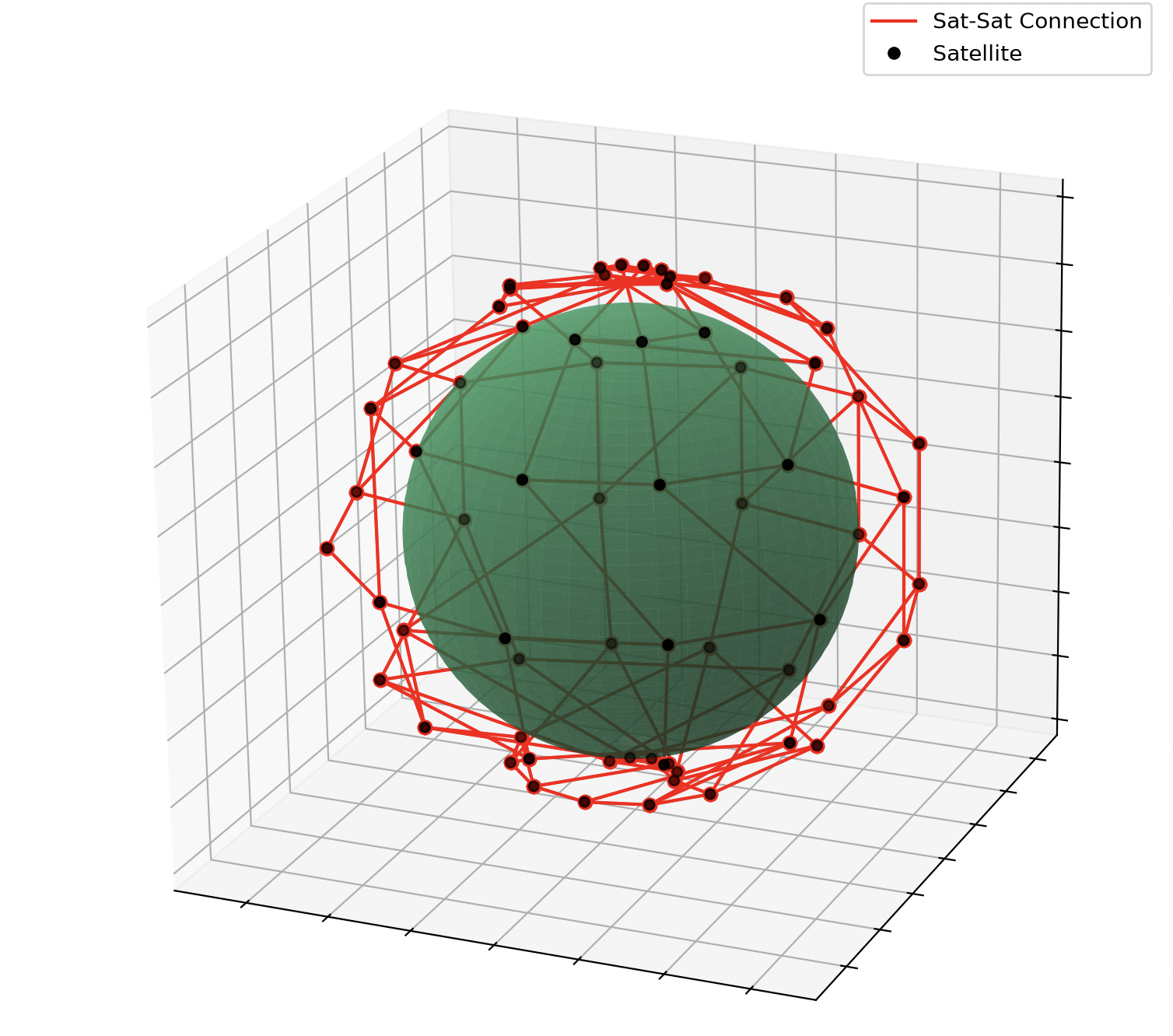
Visual Results
BibTeX
@inproceedings{
    norberto2026astra,
    title={{ASTRA}: {ADMM}-Accelerated Topology Reconfiguration for Dynamic Satellite Constellations},
    author={João Norberto and Ricardo Ferreira and Cláudia Soares},
    booktitle={The Fortieth Annual Conference on Neural Information Processing Systems},
    year={2026},
    url={https://openreview.net/forum?id=0qiq9LNYTm}
}